Engine test · Image to video

Best image-to-video AI in 2026: one photo, five engines, three runs each

We gave Wan 3.0, Seedance 1.5 Pro, Wan 2.7, Grok Imagine and Kling 2.6 the same photo and prompt, ran each engine three times, and checked all 15 clips frame by frame. Wan 3.0 scored highest, with 52 of 54, and rendered in about 80 seconds. Seedance 1.5 Pro came second with 50, for a third of the credits.

By the ClipRush team · Tested · 15 clips, 150 seconds of video

The short answer

Results

Total score over three runs (nine criteria, 0–2 points each per run), with what a 10-second clip cost and how long it took.

  1. 1. Wan 3.0Best overall

    52 / 54

    The cleanest clips in the test, with a smooth push-in in all three runs, a cup label that stayed sharp for six seconds and the fullest soundtrack. It costs the most.

    • Weakest run: 17/18
    • 50 credits ($3.80–4.75)
    • Avg. render: 1 min 20 s
    • 718×1280, 30 fps
  2. 2. Seedance 1.5 ProBest value

    50 / 54

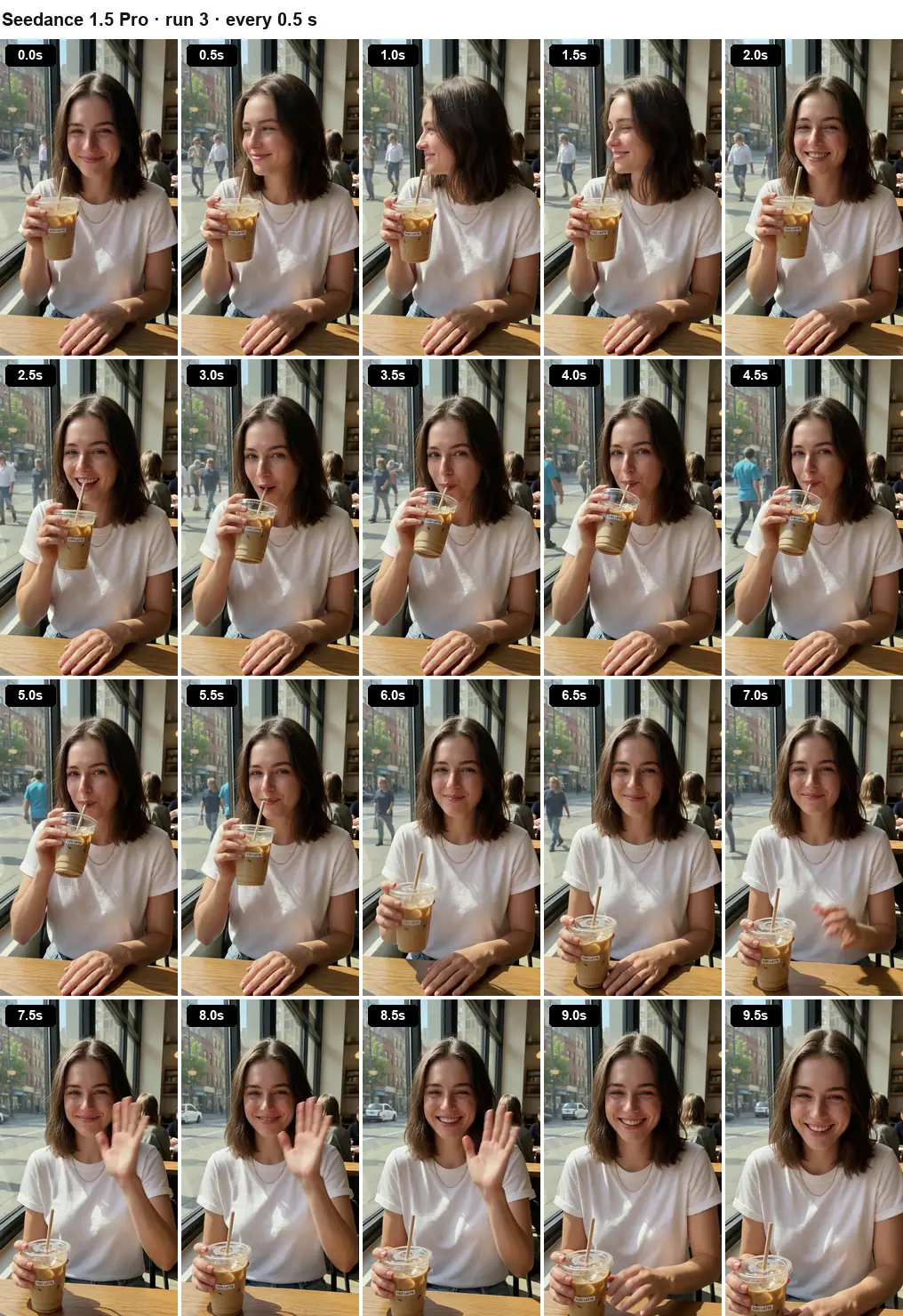
    Every beat, in order, in all three runs, with the most natural waves in the test. It scored 96% of Wan 3.0's points for a third of the credits.

    • Weakest run: 16/18
    • 16 credits ($1.22–1.52)
    • Avg. render: 2 min 7 s
    • 720×1280, 24 fps
  3. 3. Wan 2.7Good acting, wandering camera

    44 / 54

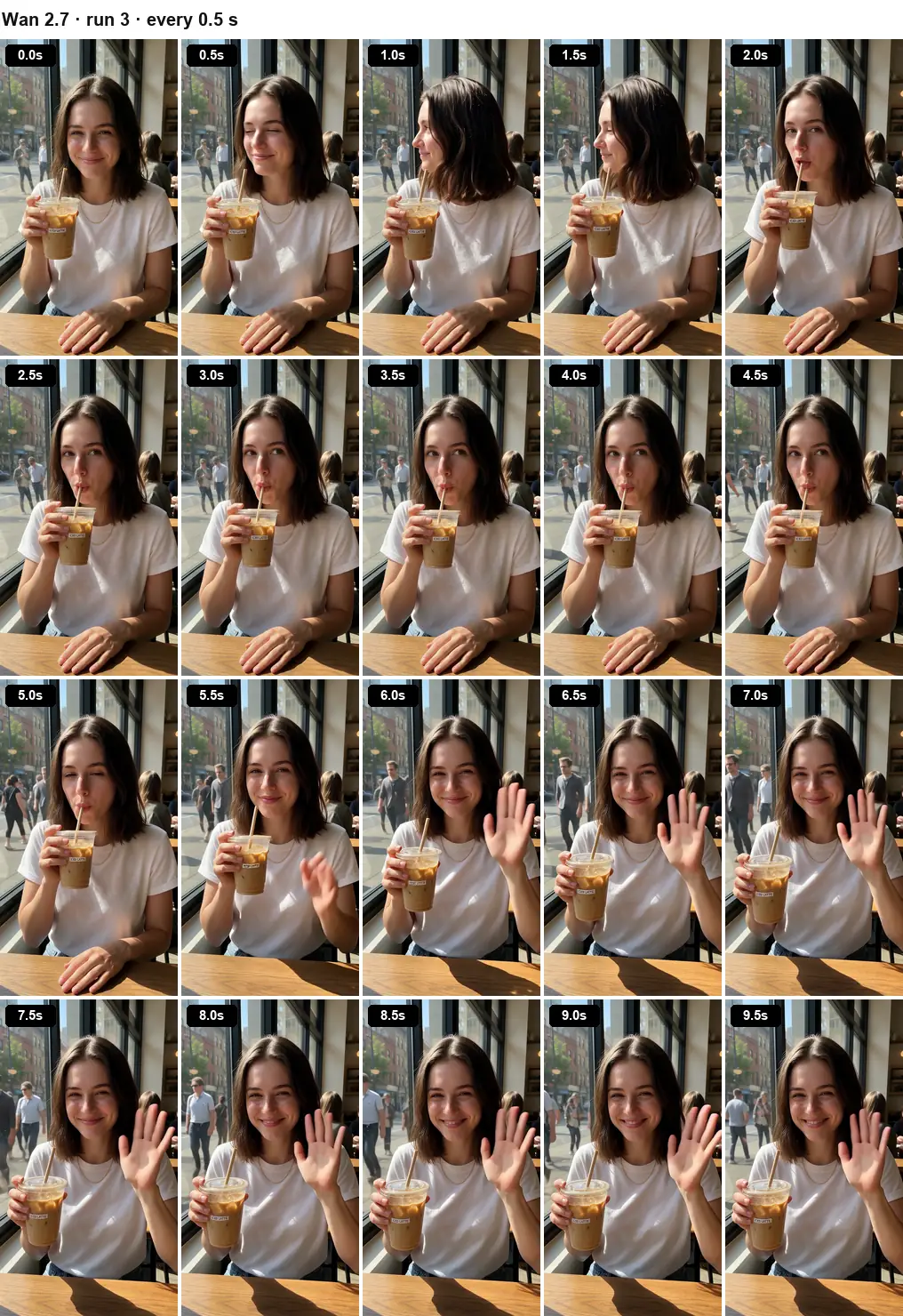
    The acting was right in every run, but in two of three, the camera kept moving after the push-in and left the woman behind.

    • Weakest run: 13/18
    • 20 credits ($1.52–1.90)
    • Avg. render: 1 min 19 s
    • 718×1280, 30 fps
  4. 4. Grok ImagineNatural motion, broken text

    39 / 54

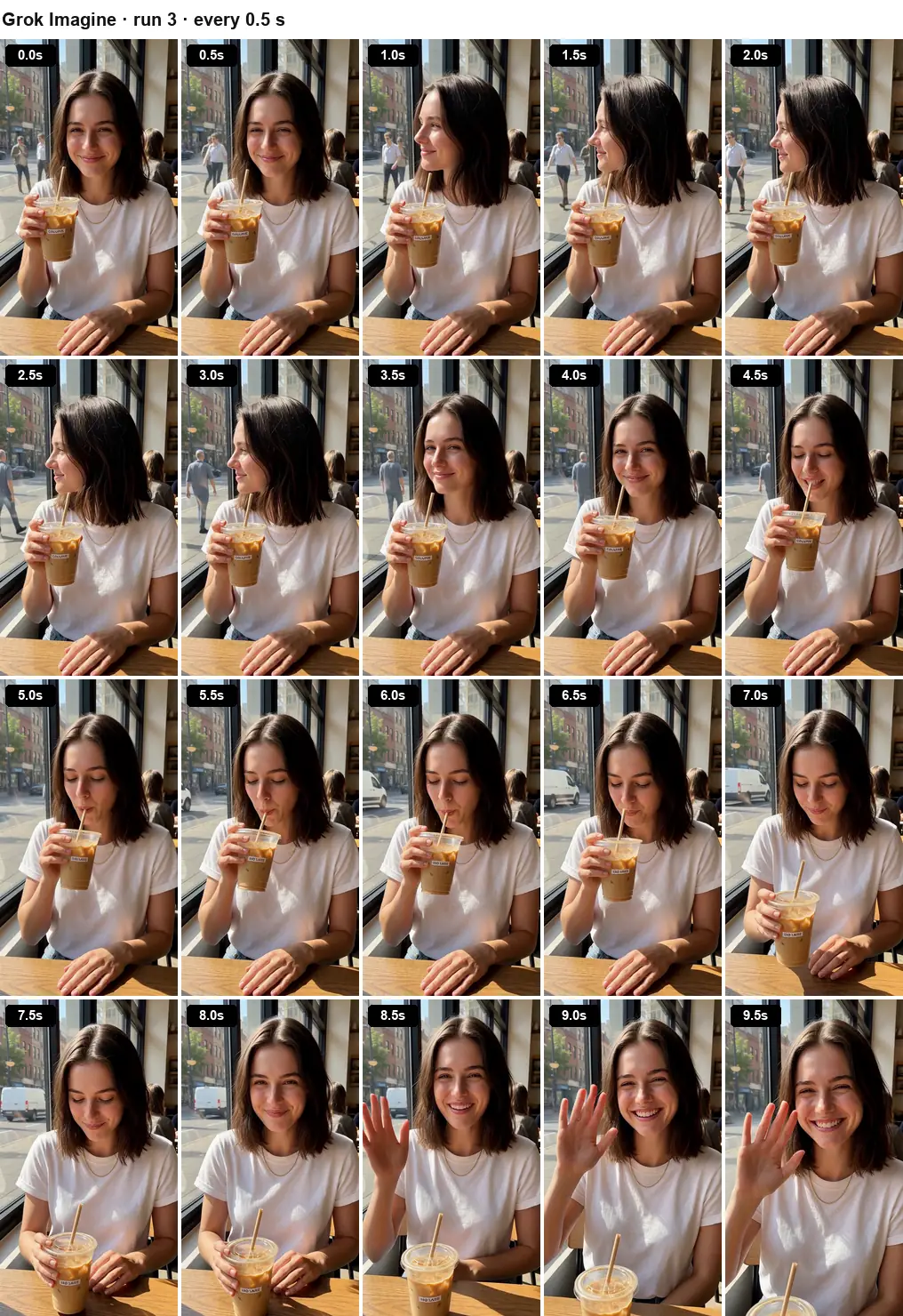
    Relaxed, believable acting and clean hands, but the cup text was garbled from the first frame, and the soundtrack was barely audible.

    • Weakest run: 12/18
    • 30 credits ($2.28–2.85)
    • Avg. render: 2 min 21 s
    • 708×1302, 24 fps
  5. 5. Kling 2.6Sharpest frames, weakest finish

    30 / 54

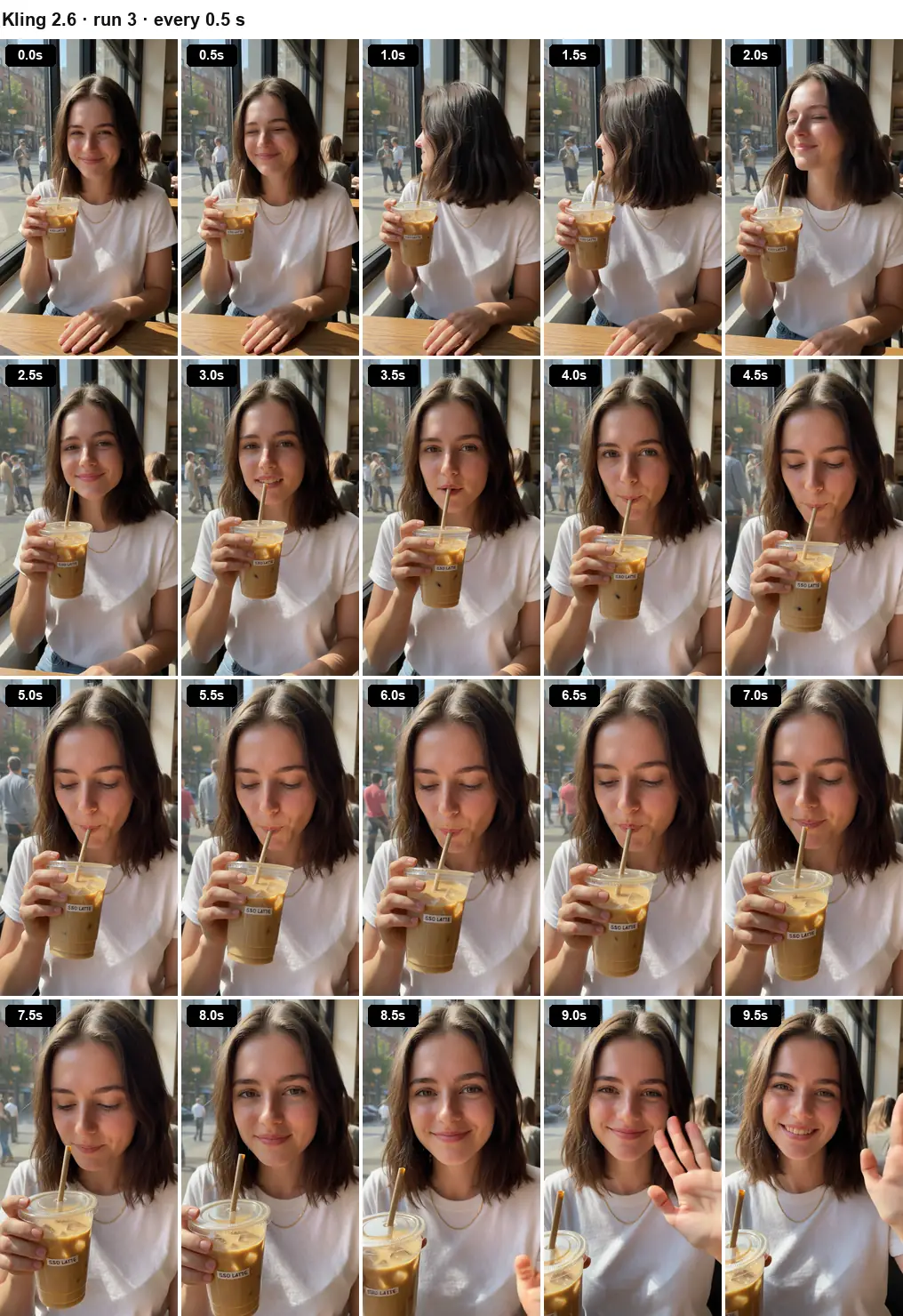
    The most detailed frames and boldest head turn, but every run pushed in too close and moved the wave to the edge of the frame. It was also the slowest by far.

    • Weakest run: 10/18
    • 20 credits ($1.52–1.90)
    • Avg. render: 4 min 7 s
    • 1076×1920, 24 fps

No cherry-picking

All 15 clips

Every run we made, in order. The loops play muted; open any clip to hear its soundtrack.

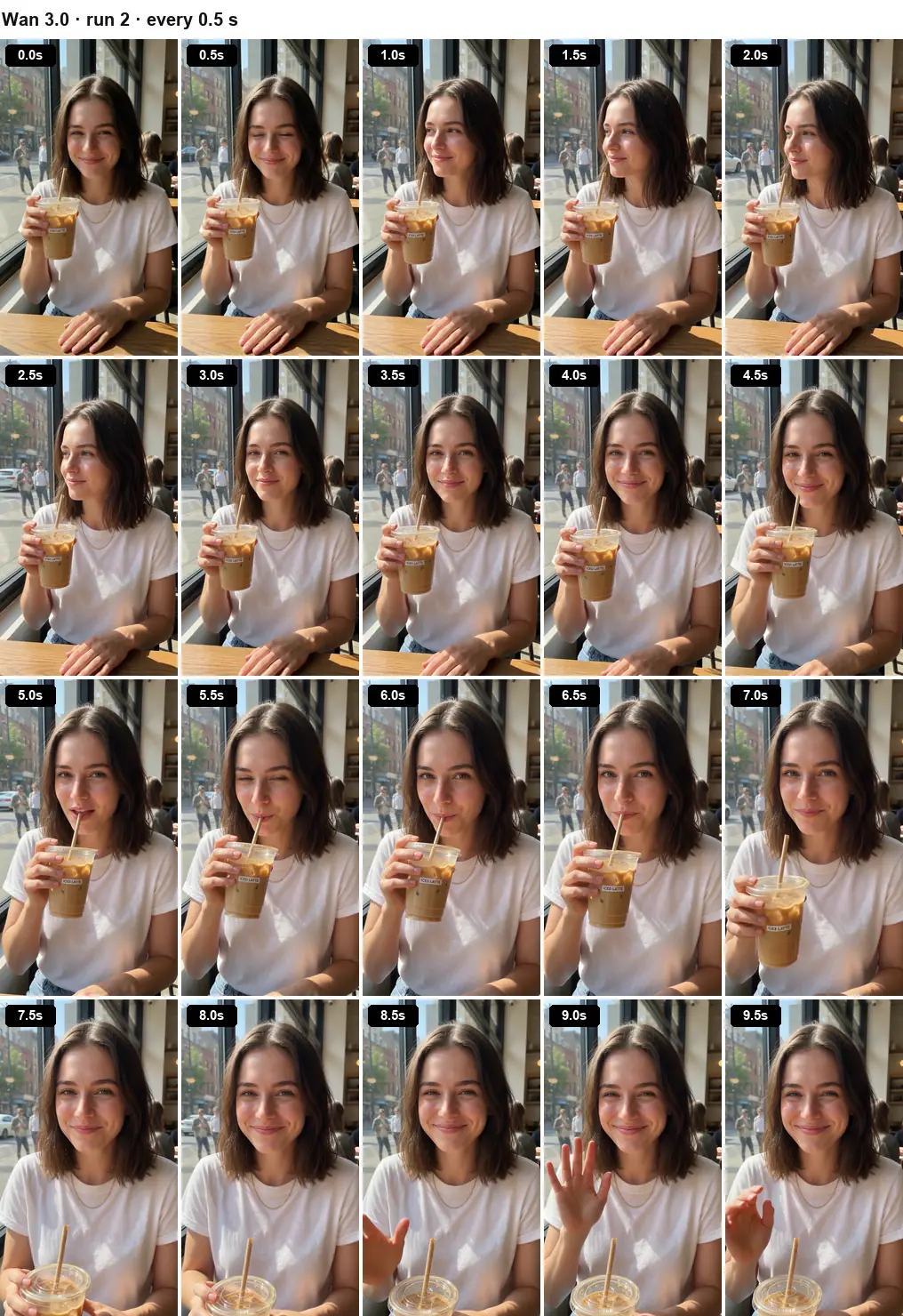
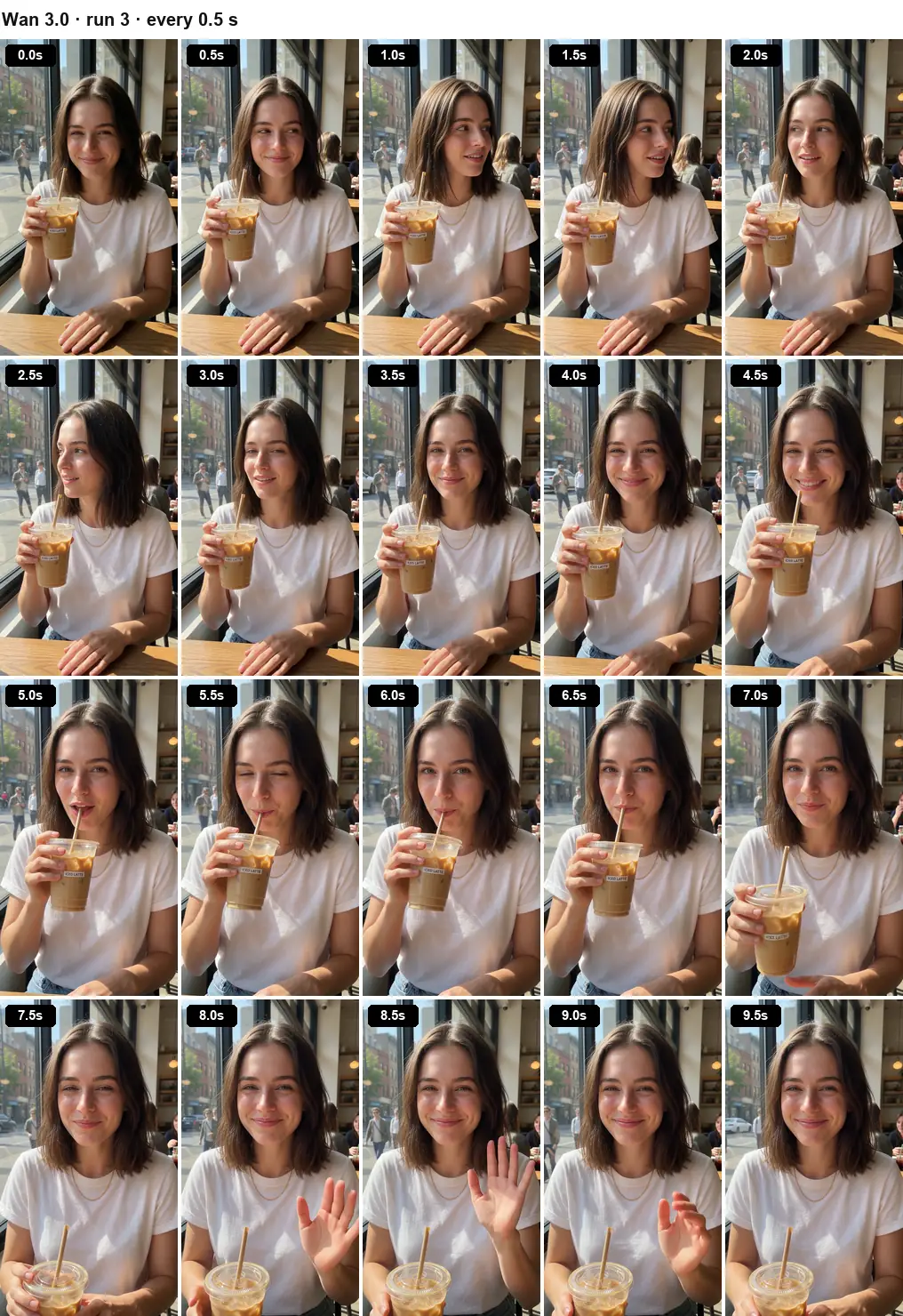
Wan 3.0

52/54

Run 1 · 17/18
Play with sound
Run 2 · 18/18
Play with sound
Run 3 · 17/18
Play with sound

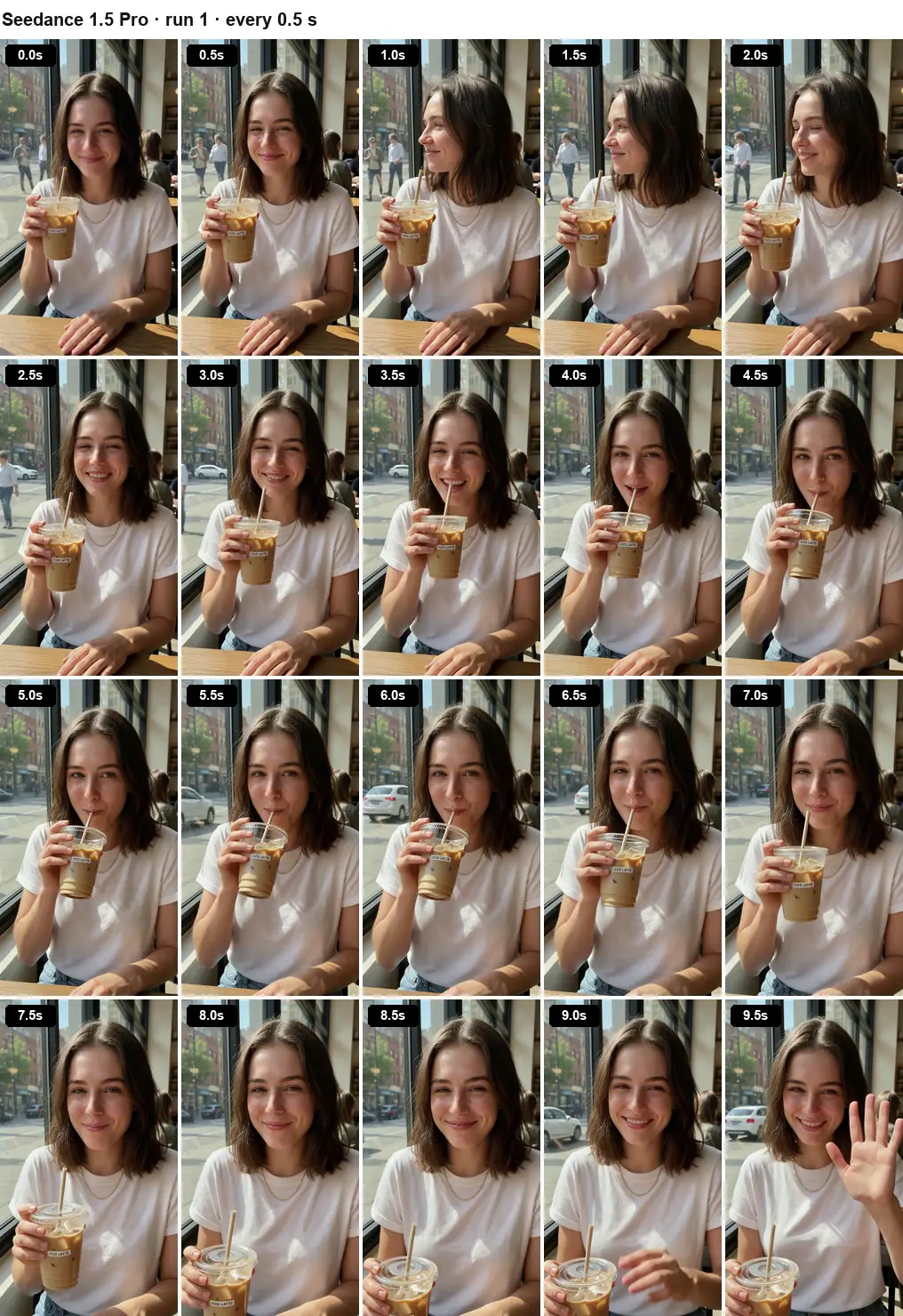
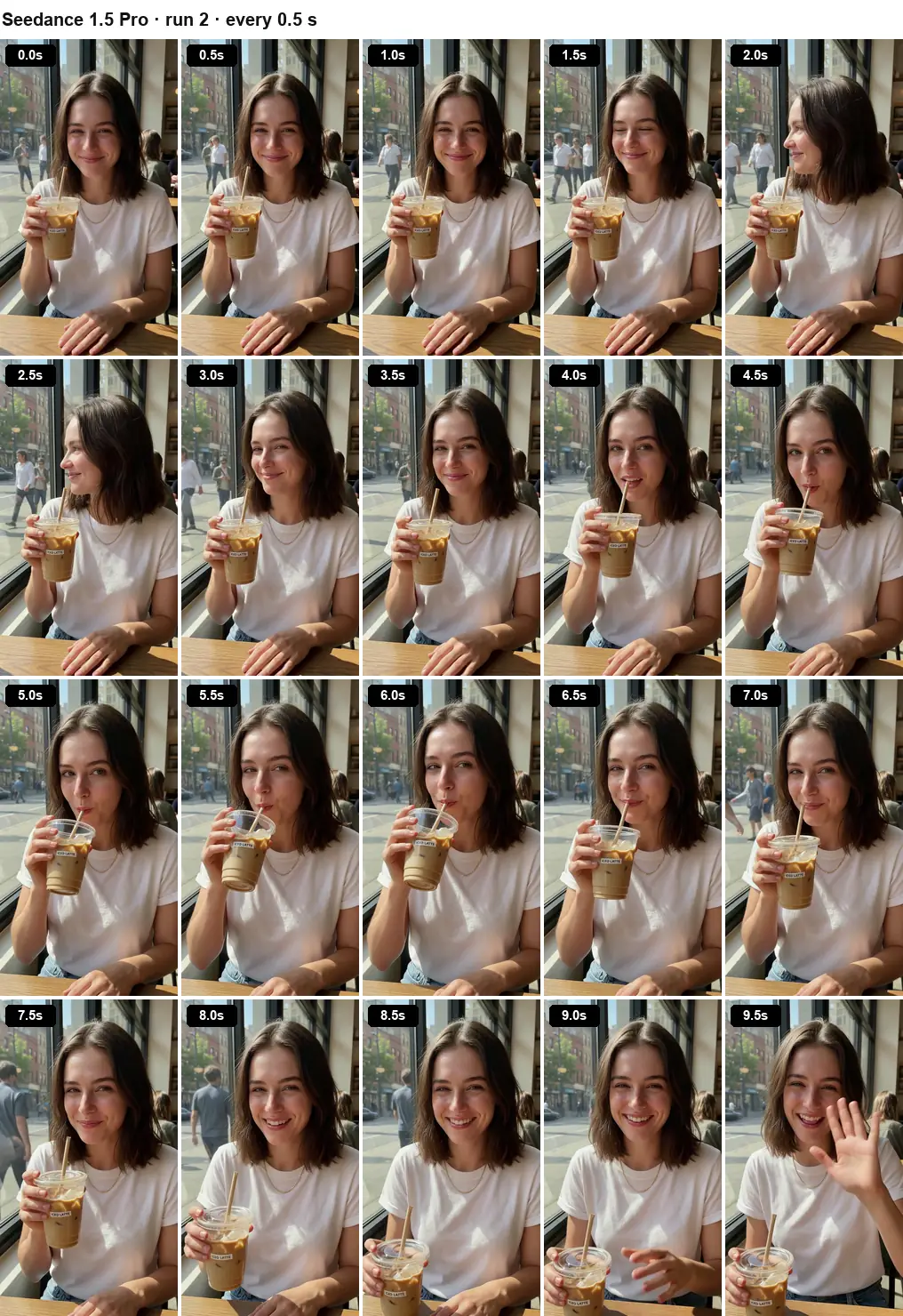
Seedance 1.5 Pro

50/54

Run 1 · 17/18
Play with sound
Run 2 · 16/18
Play with sound
Run 3 · 17/18
Play with sound

Wan 2.7

44/54

Run 1 · 15/18
Play with sound
Run 2 · 13/18
Play with sound
Run 3 · 16/18
Play with sound

Grok Imagine

39/54

Run 1 · 14/18
Play with sound
Run 2 · 12/18
Play with sound
Run 3 · 13/18
Play with sound

Kling 2.6

30/54

Run 1 · 10/18
Play with sound
Run 2 · 10/18
Play with sound
Run 3 · 10/18
Play with sound

Method

How we tested

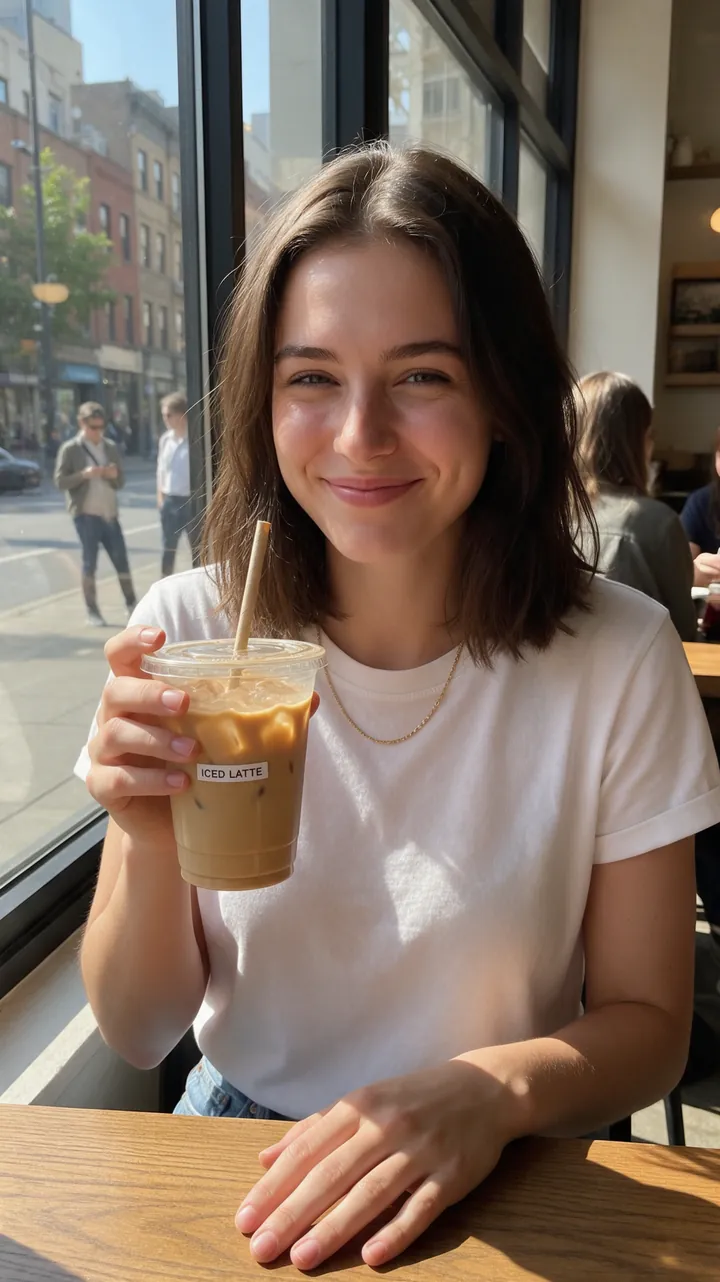
The source photo: a young woman at a sunny cafe table by a window, holding an iced latte labelled ICED LATTE
A vertical, waist-up photo we generated with ClipRush Text to Image. It is designed to trip up engines: printed text on the cup, a thin gold necklace, a straw and ice, a hand resting on the table, and people outside the window.

The prompt, word for word

“She glances out the window, then turns back to the camera, takes a sip of her iced latte through the straw, lowers the cup and waves at the camera with her free hand, smiling. Slow push-in, people walk past outside.”

Six actions in one take, a camera instruction and moving people in the background: enough to separate the engines in ten seconds. The head turn tests whether the face survives, the cup label tests fine detail, and the wave tests hands.

  • 10-second clips, 720p, sound on. Kling 2.6 ran at 1080p; its price is the same at every resolution.
  • No seed, no negative prompt, no per-engine tweaks: every engine got the same photo and the same prompt.
  • One difference is built into the studio. For Wan 3.0, ClipRush rewrites any prompt under 600 characters into a longer, structured one before rendering, so our 214-character prompt reached Wan 3.0 expanded. The other four engines received it word for word.
  • Three runs per engine, submitted back to back on October 20, 2026, between 12:42 and 12:46 UTC. All 15 clips are on this page; none were re-rolled.
  • Nine criteria per run, with 0–2 points each: 2 = clean, 1 = a visible slip, 0 = failed. That is 18 points per run and 54 per engine.
  • We stepped through every clip at half-second intervals, then went frame by frame around the head turn, sip and wave.
  • We tracked the cup label second by second against the source photo, measured loudness (EBU R128), and used an audio model to describe each soundtrack and catch speech, music and glitches.

The nine criteria

Same face
She stays the same person through the head turn and until the last frame.
Follows the prompt
All six beats appear on screen, in order: glance out, turn back, sip, lower the cup, wave, smile. Nothing extra.
Hands
Five fingers, natural poses, and no smearing or ghosting during the wave.
Cup and straw
The straw reaches her lips, the drink and ice behave naturally, and the cup stays one solid object.
Pacing
Natural speed. No beat dominates the clip, with no frozen stretches or rushed ending.
Camera
A slow push-in that keeps her and the action in the frame.
Background
People outside keep walking, and the cafe remains the same place.
Small detail
The “ICED LATTE” label, necklace and hair stay intact.
Sound
A soundtrack that fits the scene, at a usable level and without glitches.

Breakdown

Scores by criterion

Points out of 6 per criterion (three runs × 2).

CriterionWan 3.0Seedance 1.5 ProWan 2.7Grok ImagineKling 2.6
Same face66663
Follows the prompt46662
Hands66663
Cup and straw66666
Pacing65643
Camera65143
Background66466
Small detail65300
Sound65614
Total (of 54)5250443930
Credits per clip5016203020
Avg. render time1 min 20 s2 min 7 s1 min 19 s2 min 21 s4 min 7 s
Avg. loudness−22 LUFS−28 LUFS−31 LUFS−48 LUFS−32 LUFS

Engine by engine

What each engine got right and wrong

1. Wan 3.0: best overall

by Alibaba · In ClipRush it runs with a built-in prompt writer: our short prompt reached it expanded into a longer, structured one.

The cleanest clips in the test, with a smooth push-in in all three runs, a cup label that stayed sharp for six seconds and the fullest soundtrack. It costs the most.

Read our full Wan 3.0 review: every mode, 31 clips

Score

52 / 54

Per 10 s clip

50 credits

Avg. render

1 min 20 s

Loudness

−22 LUFS

What worked

  • The only engine to deliver the slow push-in in every run, ending on a chest-up portrait with the wave fully in frame.
  • “ICED LATTE” stayed readable from 0 to 6 seconds in all three runs, smearing only during the fast move as the cup came down.
  • Clean five-finger waves every time.
  • The richest, loudest soundtrack: cafe murmur, footsteps and a straw sip, averaging about −22 LUFS.
  • Tied for fastest at about 80 seconds per clip.

What didn’t

  • In runs 1 and 3, she looks into the cafe first and only glances at the window at 2–2.5 seconds. Run 3 adds lip movement, as if she were talking.
  • Her head turns only three-quarters, never reaching a full profile, so identity is tested less than with the others.
  • The most expensive engine here: 50 credits for 10 seconds at 720p.

Run by run

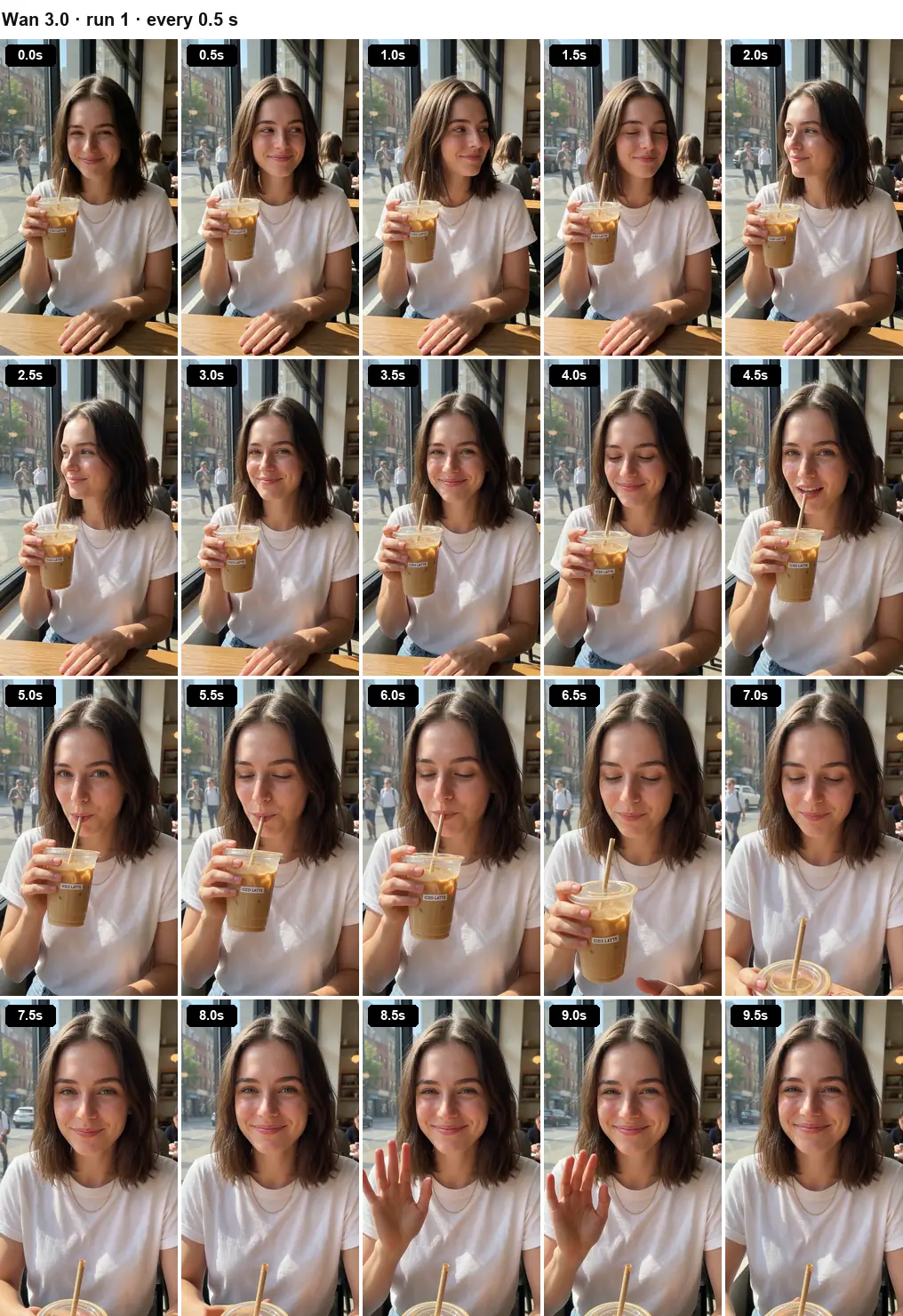
  • Run 1 · 17/18 · 1 min 20 s
    Looks into the cafe at 0.5–1.5 s, glances at the window at 2.0–2.5 s, and faces the camera by 3.0 s. Sips at 4.5–6.0 s with the label sharp; it smears as the cup drops at 6.5 s. Push-in to a portrait from 7 s, then a wave at 8.25–9.0 s.
  • Run 2 · 18/18 · 1 min 15 s
    Window glance at 1.0–2.5 s, back to the camera at 3.0 s, sip at 5.0–6.0 s, cup lowered at 7.0 s, and wave at 8.5–9.25 s. The only perfect run in the test.
  • Run 3 · 17/18 · 1 min 24 s
    Looks into the cafe and moves her lips at 0.5–2.0 s, then glances at the window at 2.5 s. Sip at 5.0–6.0 s, label smears at 7.0 s, and wave at 8.0–8.75 s.
See every half second of all three runs

2. Seedance 1.5 Pro: best value

by ByteDance

Every beat, in order, in all three runs, with the most natural waves in the test. It scored 96% of Wan 3.0's points for a third of the credits.

Score

50 / 54

Per 10 s clip

16 credits

Avg. render

2 min 7 s

Loudness

−28 LUFS

What worked

  • Followed the prompt beat for beat in every run, without adding anything.
  • Natural, open-palm waves with five fingers, fully in frame, in every run.
  • Expressive without changing the face: she laughs and smiles with her teeth showing but still looks like the photo.
  • Kept the label readable in two of three runs.
  • The cheapest engine here, at 16 credits per 10-second clip.

What didn’t

  • Run 2 stands still for the first second, then squeezes the wave into the final second.
  • Run 3 barely pushes in.
  • Our audio check flagged a faint hum and hiss in run 1.
  • About 2 minutes per clip, at 24 fps rather than 30.

Run by run

  • Run 1 · 17/18 · 2 min 4 s
    Window glance at 1.0–1.5 s, laughs at 2.5–3.5 s, and sips at 4.0–6.5 s as a car passes outside. Lowers the cup at 7.0 s and waves at 9.0–9.9 s.
  • Run 2 · 16/18 · 2 min 13 s
    Holds still for the first second, glances out at 1.5–2.5 s, sips at 4.0–6.5 s, then laughs and waves at 9.0–9.9 s. The first letters of the label smear from 5 s.
  • Run 3 · 17/18 · 2 min 4 s
    The best-paced run in the test: glance at 0.5–1.0 s, sip at 2.5–5.0 s, cup set down at 6.0 s, wave at 7.0–8.5 s, and smiling to the end. The camera hardly moves.
See every half second of all three runs

3. Wan 2.7: good acting, wandering camera

by Alibaba

The acting was right in every run, but in two of three, the camera kept moving after the push-in and left the woman behind.

Score

44 / 54

Per 10 s clip

20 credits

Avg. render

1 min 19 s

Loudness

−31 LUFS

What worked

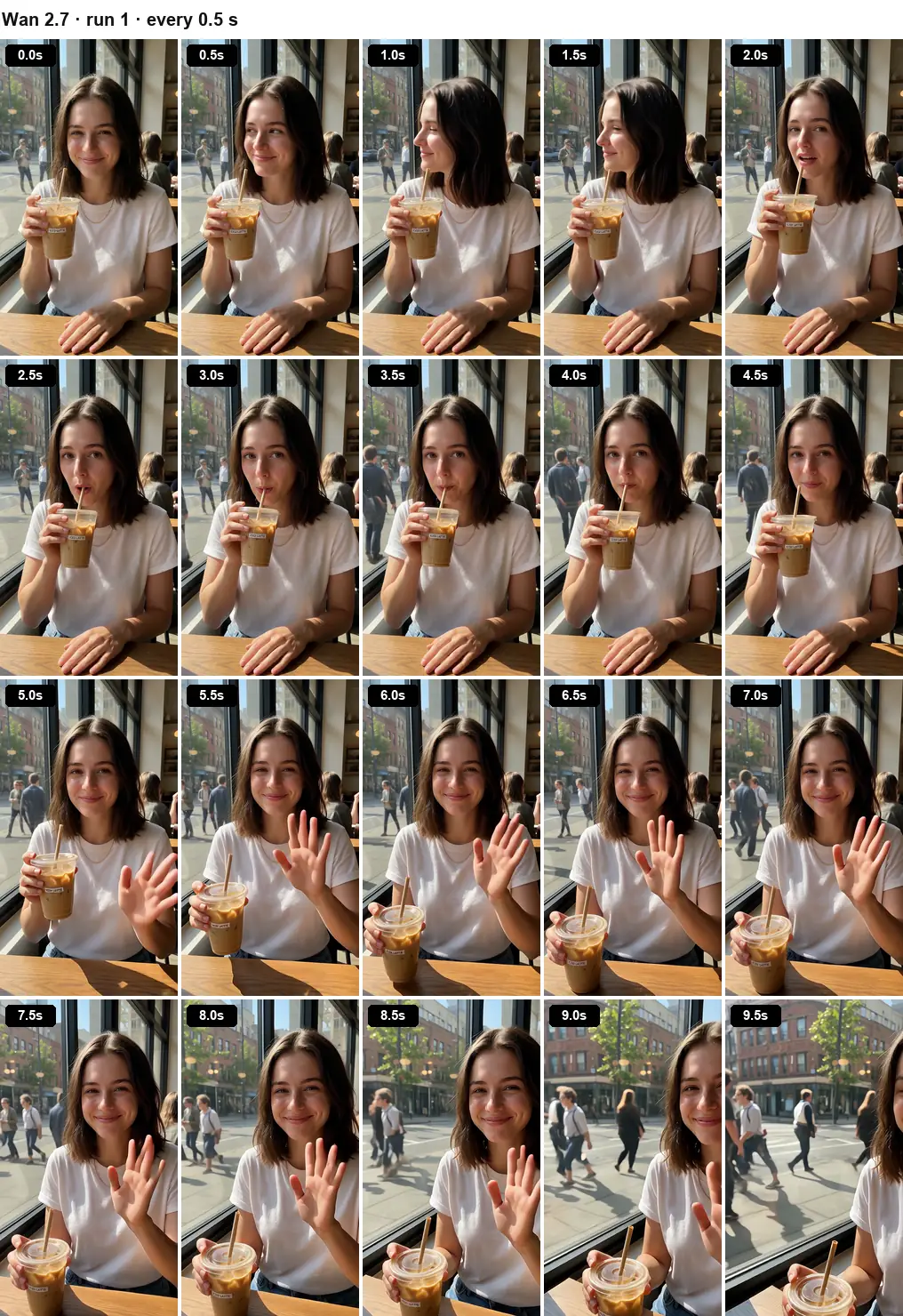
  • All six beats, in order, in every run, starting with a clear, full-profile look out the window.
  • Clean waves and a convincing sip.
  • Natural cafe ambience with an audible straw sip.
  • About 80 seconds per clip for 20 credits.

What didn’t

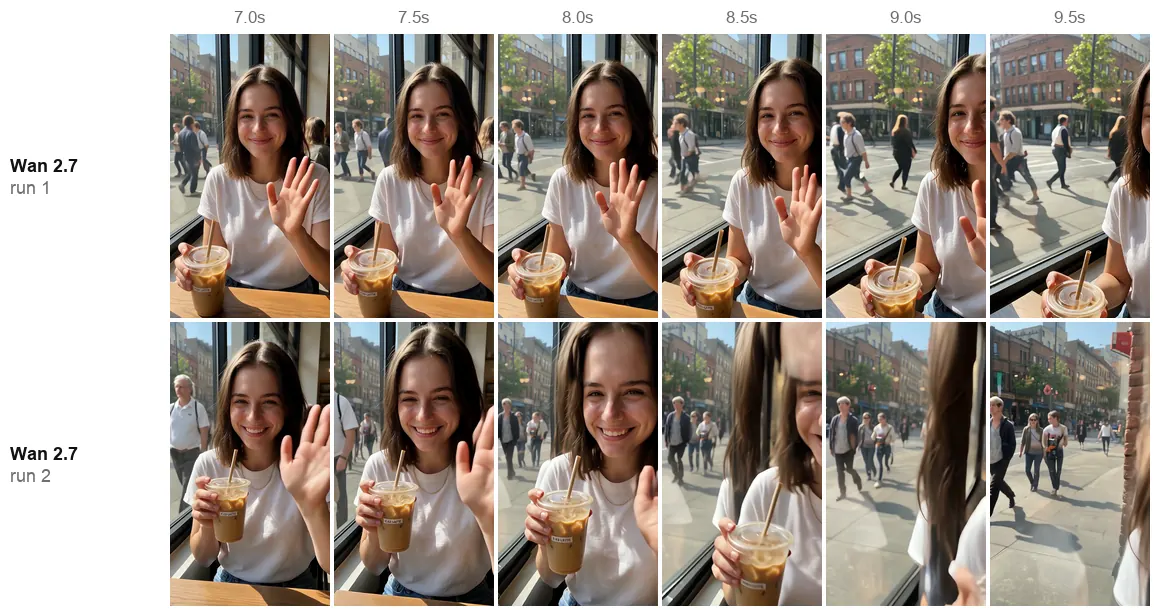
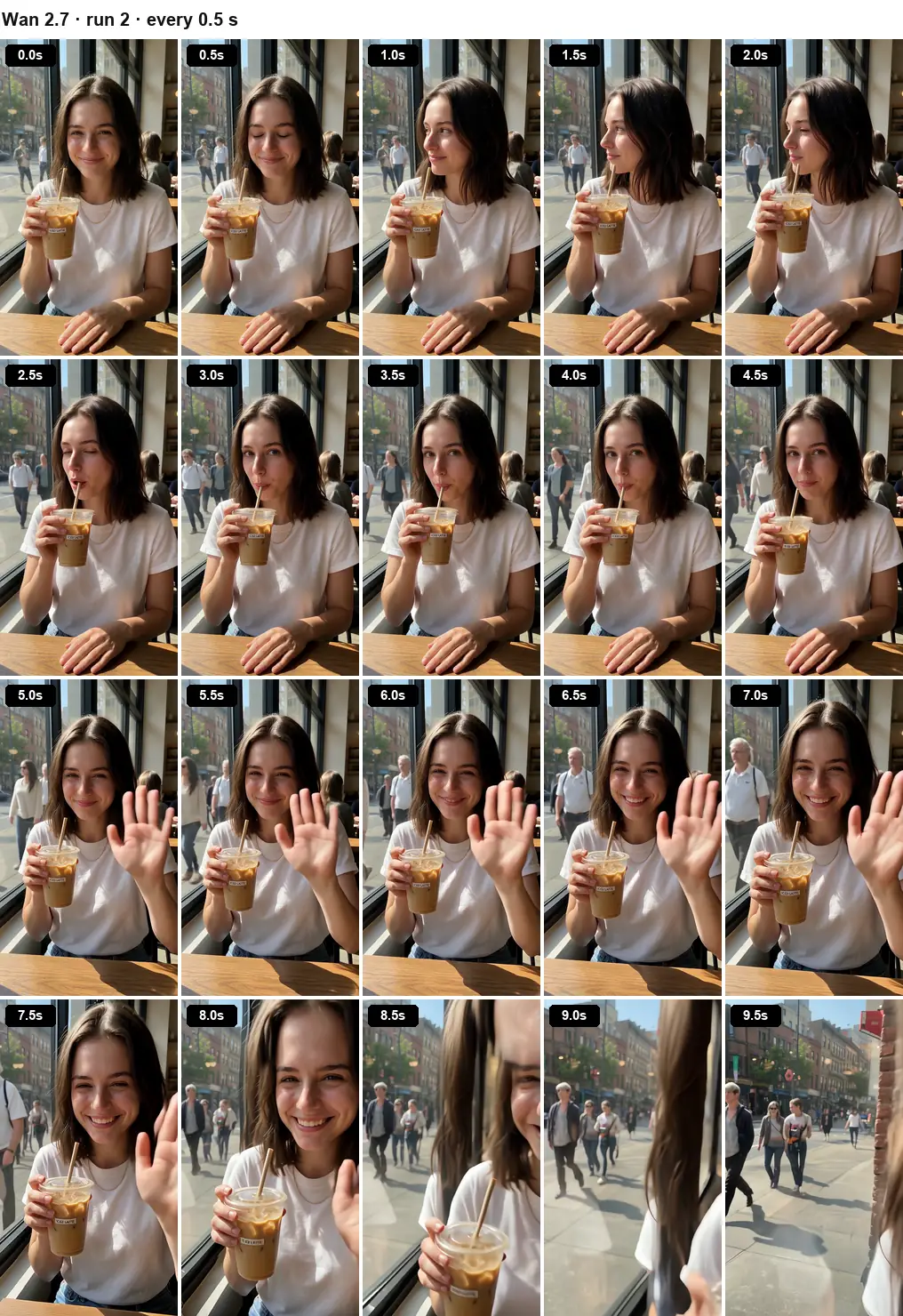
  • In runs 1 and 2, the camera drifted toward the window after 7.5 seconds. Run 1 ends on the street with her shoulder at the edge of the frame; run 2 ends outside on the sidewalk without her.
  • “ICED” turned into “ICOD” from about 2 seconds in every run.
  • Run 3 behaves, but its push-in is barely visible.

Run by run

  • Run 1 · 15/18 · 1 min 19 s
    Full-profile window glance at 0.5–1.0 s, sip at 2.0–4.0 s, and wave from 5.0 s. The camera then pans to the window; by 9.0 s, only her shoulder remains at the edge, and we are looking at the street.
  • Run 2 · 13/18 · 1 min 14 s
    Glance at 0.5–2.0 s, sip at 2.5–4.0 s, and a big, laughing wave at 4.5–7.0 s. At 7.5 s, the camera rushes toward her face, swings past her hair and ends up outside on the sidewalk at 9.0–9.5 s.
  • Run 3 · 16/18 · 1 min 25 s
    Glance at 0.5–1.0 s, a long sip at 2.0–5.0 s, and a wave from 5.5 s to the end. Clean, with almost no push-in.
Wan 2.7 runs 1 and 2 from 7 to 9.5 seconds: the camera drifts to the window and ends on the street without the woman
Wan 2.7, runs 1 and 2, 7.0–9.5 s: after the wave the camera keeps going. Run 1 ends on the street; run 2 ends outside on the sidewalk.
See every half second of all three runs

4. Grok Imagine: natural motion, broken text

by xAI · Listed as Grok 4.1 in our studio; it runs xAI's Grok Imagine video model.

Relaxed, believable acting and clean hands, but the cup text was garbled from the first frame, and the soundtrack was barely audible.

Score

39 / 54

Per 10 s clip

30 credits

Avg. render

2 min 21 s

Loudness

−48 LUFS

What worked

  • Unhurried, natural acting. She puts the cup on the table before waving, the most human choice in the test.
  • Every beat, in order, in all three runs, with clean hands.
  • The street feels alive: pedestrians and a delivery van pass the window.

What didn’t

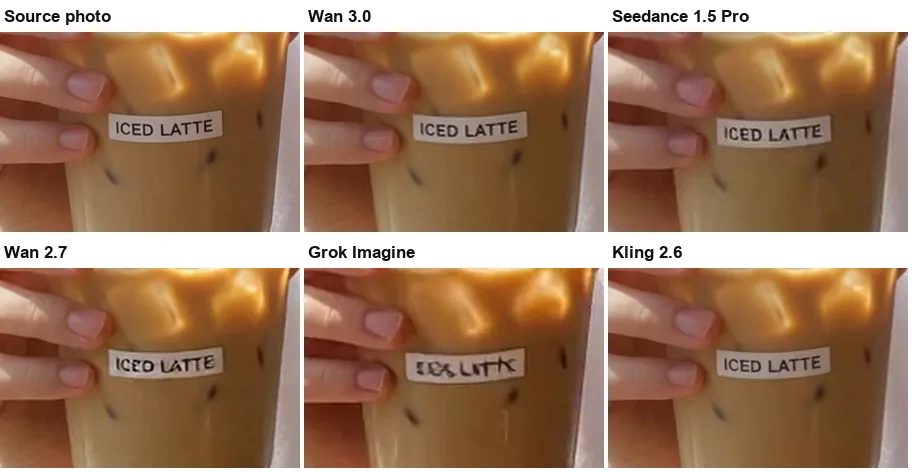
  • The label is already garbled in the first frame (“KSO LATTE”). Grok redraws the starting image instead of animating it as is, cropping its sides.
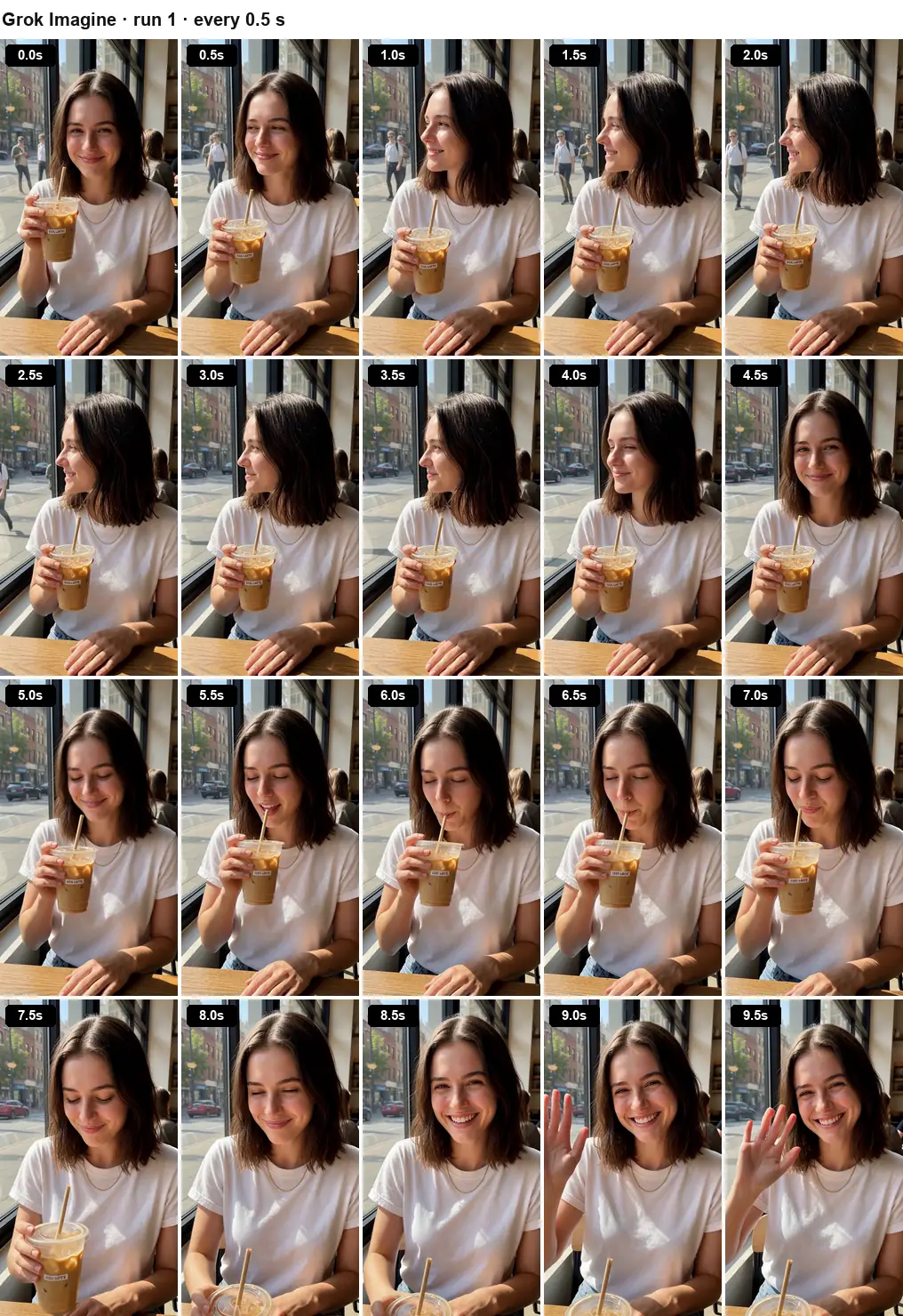
  • The window glance lasts up to 3.5 seconds, squeezing the wave into the final second.
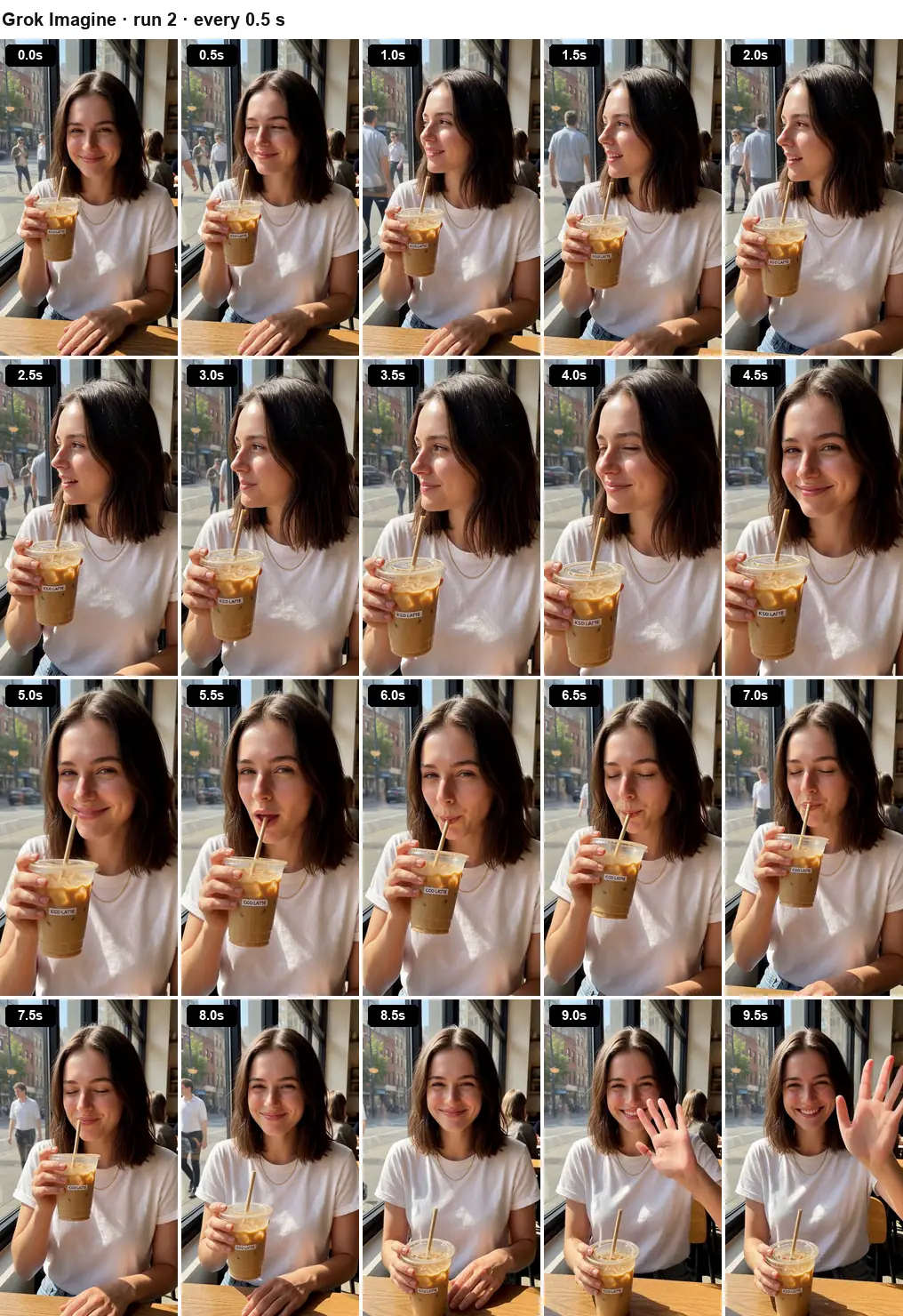
  • Camera: run 2 pushes in and then backs out; run 3 stays still until 8 seconds.
  • Soundtracks were about 20 dB quieter on average than those from the other engines (−40 to −55 LUFS against −18 to −34). Run 2 is close to silent.

Run by run

  • Run 1 · 14/18 · 2 min 22 s
    A long look out the window at 0.5–3.5 s, back to the camera at 4.0 s, sip with eyes closed at 5.0–6.5 s, cup down at 7.5 s, and wave squeezed into the final second.
  • Run 2 · 12/18 · 2 min 14 s
    Glance and laugh at 0.5–3.5 s, sip at 5.5–7.0 s, cup down at 8.0 s, and wave at 9.0–9.9 s. The camera pushes in early, then drifts back out.
  • Run 3 · 13/18 · 2 min 28 s
    The best Grok run: glance at 1.0–3.0 s, sip at 4.5–6.0 s, cup down with both hands at 7.0 s, and a big, laughing wave at 8.5–9.9 s. A white van passes outside during the sip. The camera stays still until 8 s.
The cup label in the source photo and in the first frame of each engine; only Grok Imagine's reads as garbled text
The first frame of each engine's run 1, zoomed on the cup. Every engine starts from the photo except Grok Imagine, whose first frame already reads as nonsense.
See every half second of all three runs

5. Kling 2.6: sharpest frames, weakest finish

by Kuaishou

The most detailed frames and boldest head turn, but every run pushed in too close and moved the wave to the edge of the frame. It was also the slowest by far.

Score

30 / 54

Per 10 s clip

20 credits

Avg. render

4 min 7 s

Loudness

−32 LUFS

What worked

  • 1080p output with the finest skin, hair and ice detail in the test.
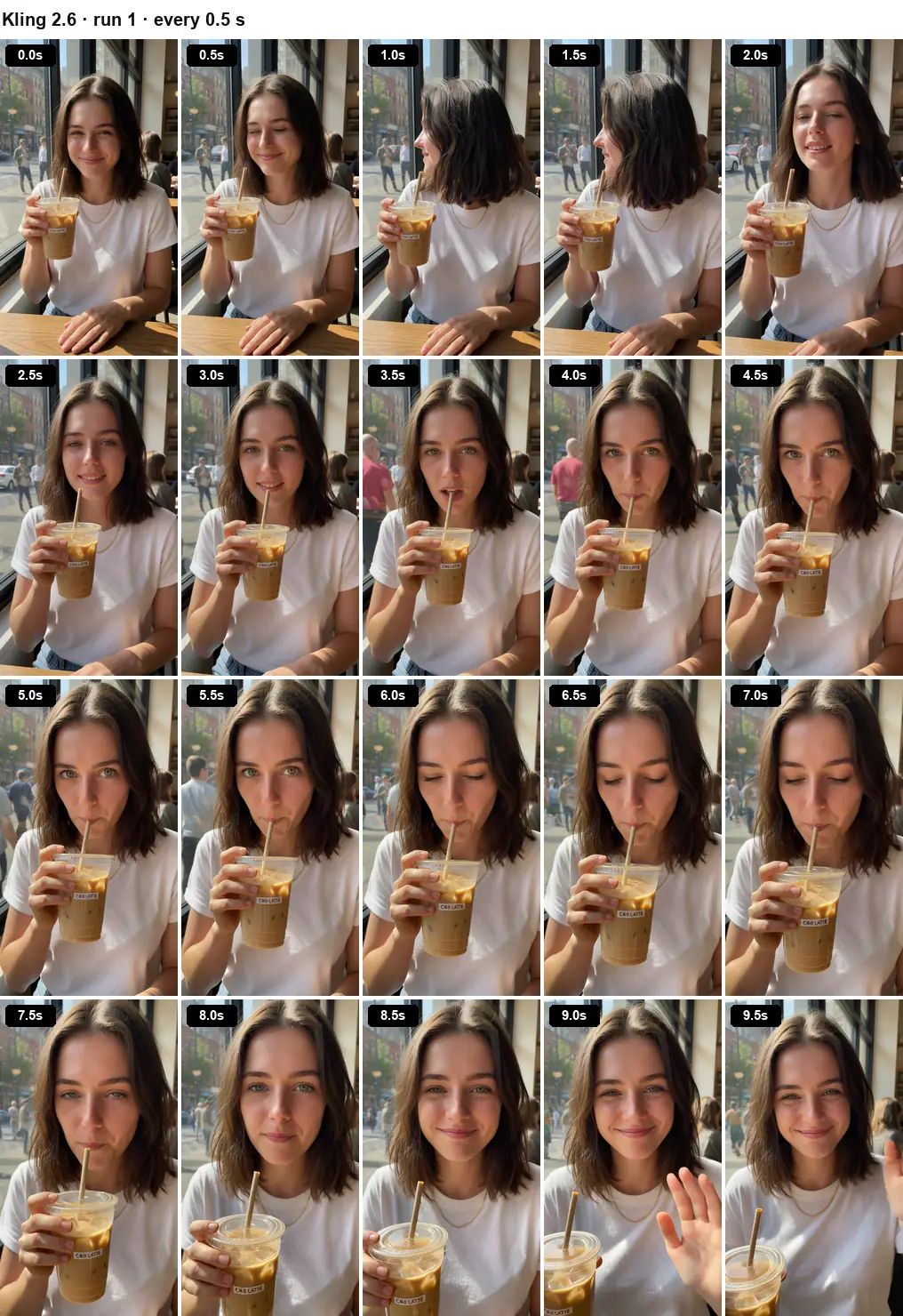
  • The boldest head turn: she looks so far out the window that we see the back of her head, then turns back as the same person.
  • The most convincing close-ups of the sip.

What didn’t

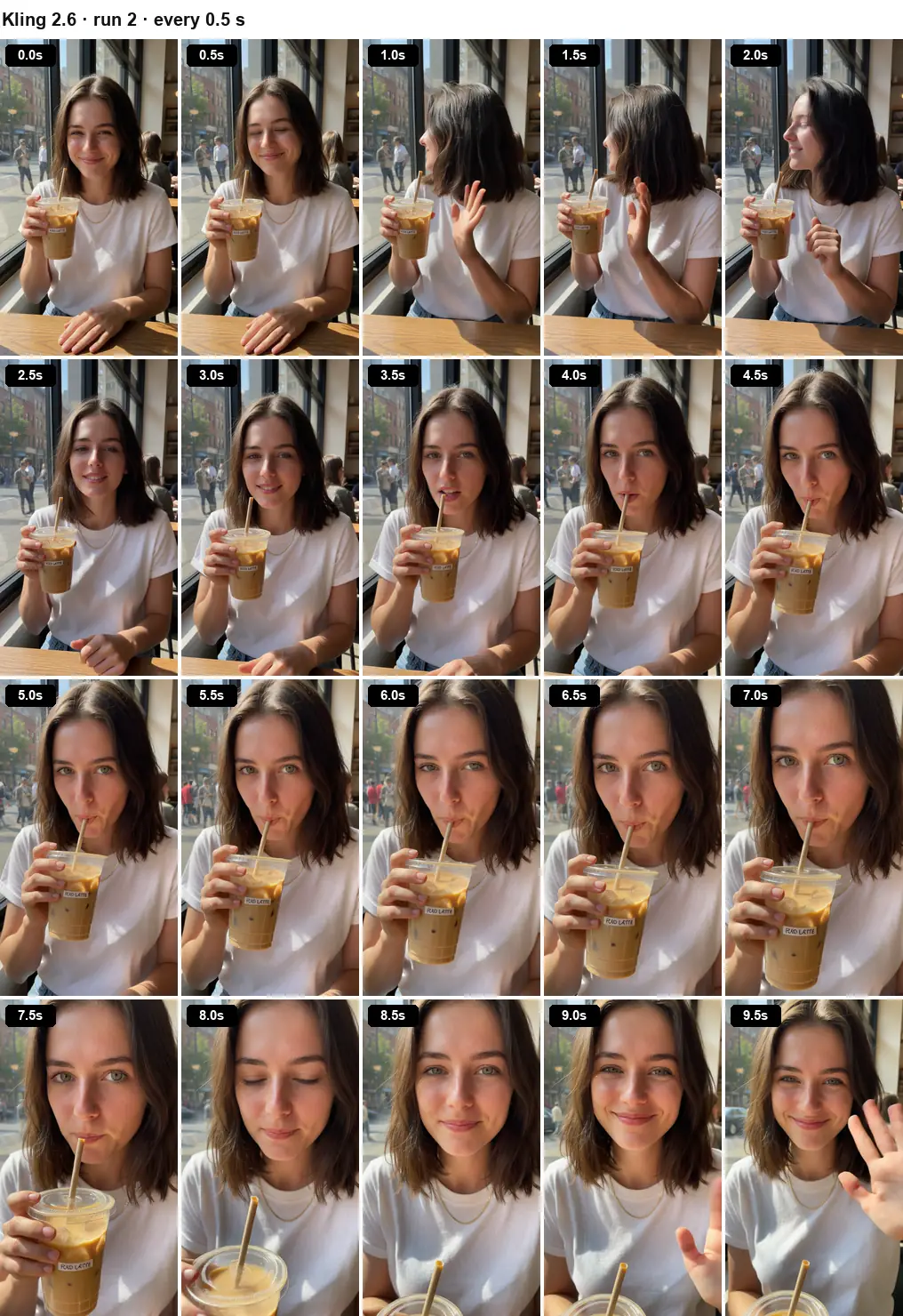
  • The push-in overshoots to a tight close-up, so the wave happens at the right edge of the frame in the final second or so of every run, with ghosted fingers.
  • Run 2 waves early, at 1.0 s, while she is still looking out the window.
  • Sips last 3.5–4 seconds, leaving no time for the ending.
  • The label turns into nonsense (“CRO LATTE”, “SSD LATTE”) from about 3 seconds.
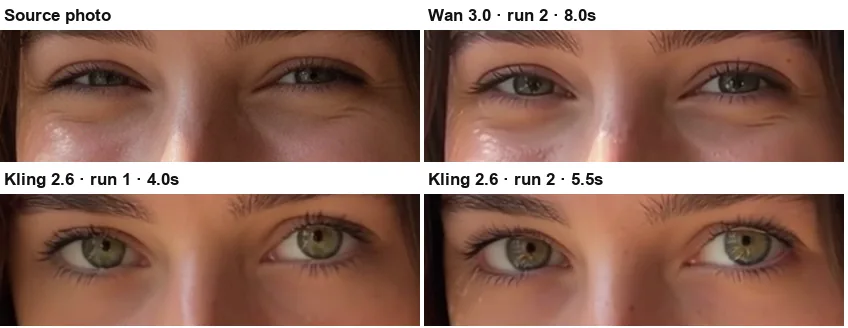
  • In close-ups, her eyes appear larger and greener than in the photo.
  • About 4 minutes per clip, three times longer than Wan.

Run by run

  • Run 1 · 10/18 · 3 min 34 s
    Turns far enough toward the window to show the back of her head at 1.0 s, returns to the camera at 2.0 s, then takes a 3.5-second close-up sip at 3.5–7.0 s. The wave starts at 9.0 s at the right edge of the frame.
  • Run 2 · 10/18 · 4 min 8 s
    Waves early, at 1.0 s, while looking out the window. Sips at 3.5–7.0 s; the final wave is half out of the frame at 9.0–9.9 s.
  • Run 3 · 10/18 · 4 min 38 s
    Window turn at 0.5–1.5 s, a 4-second sip with her eyes down at 3.0–7.0 s, and a wave at the frame edge at 8.5–9.9 s. The audio check detected a faint metallic tone.
Eyes in the source photo, in Wan 3.0 and in two Kling 2.6 close-ups, where they look larger and greener
The eyes in the photo and in Wan 3.0 match. In Kling 2.6's close-ups they come out larger and greener.
See every half second of all three runs

Takeaways

What 15 clips taught us

Text is the first thing to break

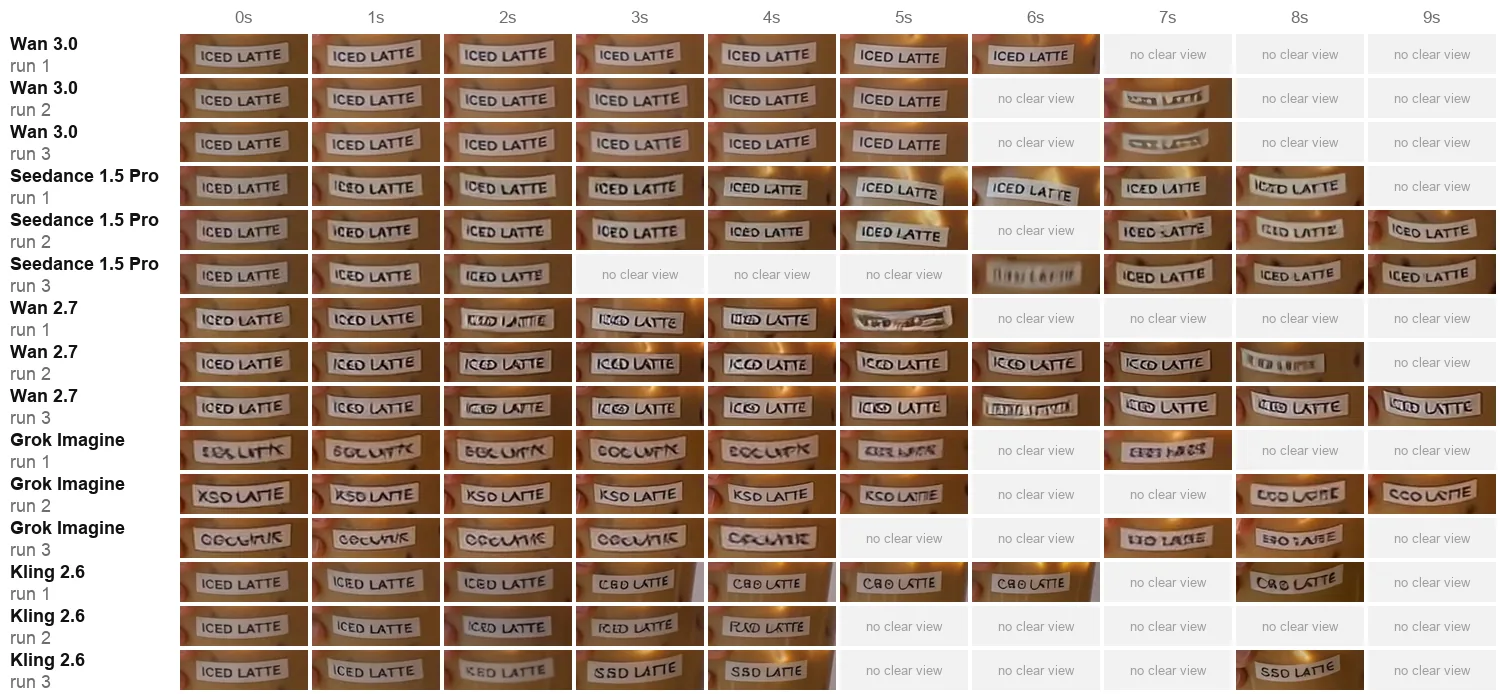
Only Wan 3.0 kept “ICED LATTE” sharp in every run; Seedance 1.5 Pro did in two of three. Wan 2.7 and Kling 2.6 rewrote it within two or three seconds, and Grok Imagine broke it on frame one. If your photo has a logo, price tag or caption, check it before posting.

The ICED LATTE cup label tracked second by second in all 15 runs
The cup label, found automatically in every second of every run. Grey cells: the label was out of shot, blurred or turned away.

A long first beat steals time from the last one

Engines that spent three or four seconds on one action, such as Grok's window glance or Kling's sip, had to cram the wave into the final second. Put the most important action early in the prompt, or request fewer actions in a 10-second clip.

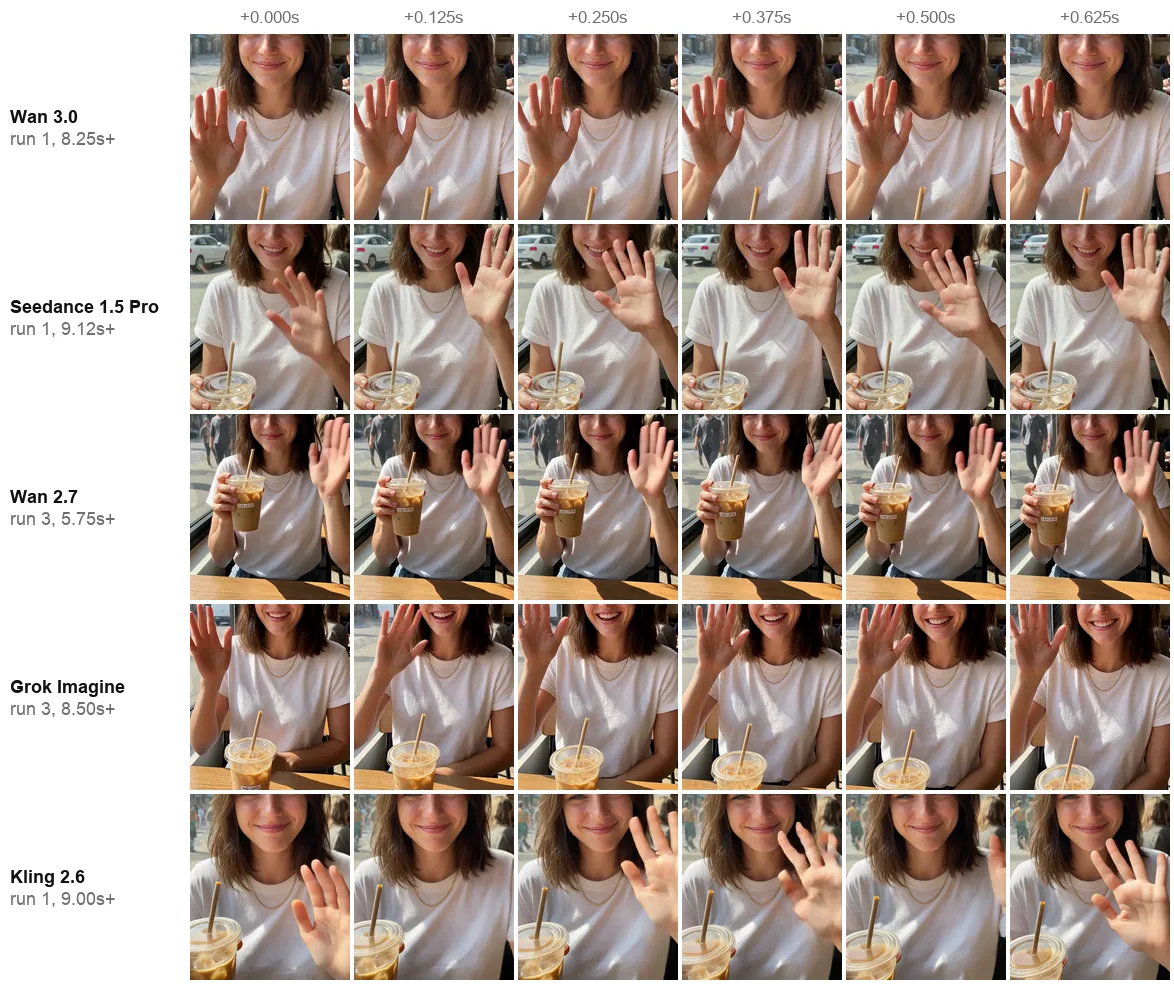
The wave frame by frame, one run per engine, every eighth of a second
The wave, one run per engine, every 1/8 s. Kling's lands at the edge of the frame in the last second; the others play out in full.

“Push-in” means something different to each engine

Wan 3.0 and Seedance moved in gently. Kling moved in so tightly that it cut off the wave, while Wan 2.7 kept going until it left the cafe. If framing matters, say where the camera should stop, for example, “push in to a chest-up shot”.

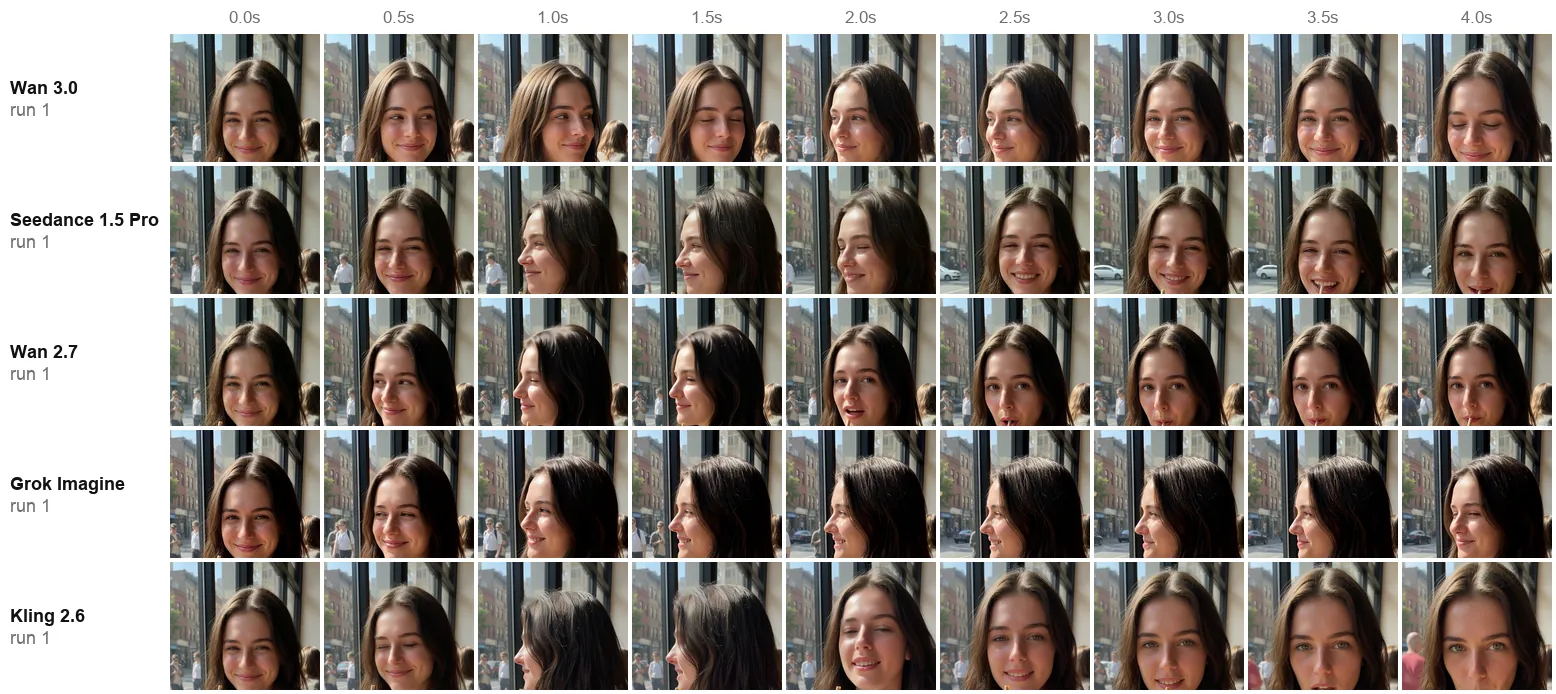
One face is mostly solved

All five engines kept the woman recognizable through the head turn and to the end. The only drift we found was Kling's larger, greener eyes in close-ups.

The head turn in run 1 of each engine, from 0 to 4 seconds
The glance out of the window in run 1, 0–4 s. Wan 3.0 looks into the cafe first; Kling turns so far we see the back of her head; Grok holds the look the longest.

Every engine added sound, none added speech or music

Nothing in the prompt described sound, yet all five generated cafe ambience, with loudness more than 30 dB apart. Wan 3.0's track was the fullest; Grok's was close to silent.

Price and speed don't predict quality

The most expensive engine was also among the fastest, while the 16-credit engine came second. Kling took about four minutes per clip and finished last.

One run tells you little

Wan 2.7's best run scored 16 of 18 and would have hidden the camera drift that spoiled the other two. Kling scored exactly 10 every time: consistent, but consistently behind the others.

Recommendations

Which engine should you use?

  • Wan 3.0: Final clips, product shots with text or logos, and anything you will post without a re-roll.

  • Seedance 1.5 Pro: Social clips at volume, people on camera, and drafts you want to look finished.

  • Wan 2.7: Fast, cheap drafts of people on camera, if you can trim the final seconds.

  • Grok Imagine: Candid, relaxed motion when on-screen text and sound do not matter.

  • Kling 2.6: Detailed 1080p close-ups when you can afford a re-roll and a 4-minute wait.

In the ClipRush studio, Wan 3.0 is the Ultra engine for image to video. The other four engines are not in the public studio; we ran them through the same pipeline for this test.

Fine print

What this test can and can’t tell you

  • One scene and one prompt. A product, animal or landscape could rank the engines differently.
  • Three runs per engine is a small sample. It shows how steady an engine is, not its average over hundreds of clips.
  • The scores reflect our judgment. Every point includes a timestamp, so you can check it against the clips. Render times, loudness and label tracking are measured.
  • Wan 3.0 had the studio's prompt writer on its side, as every ClipRush user does; the other engines had our prompt as written. Part of its lead may come from the longer prompt.
  • Versions as of October 20, 2026: Wan 3.0, Wan 2.7, Kling 2.6, Seedance 1.5 Pro and Grok Imagine. Newer Kling and Seedance versions were not included in this round.

FAQ

Questions people ask

In our October 2026 test, Wan 3.0 scored highest: 52 of 54 points across three runs, with the steadiest camera, sharpest on-screen text and fullest soundtrack. It ran in ClipRush, which expands short prompts for Wan 3.0 automatically. Seedance 1.5 Pro came second with 50 points for under a third of the credits. Wan 2.7 scored 44, Grok Imagine 39 and Kling 2.6 30.

For a person on camera, Wan 3.0 and Seedance 1.5 Pro looked the most natural in our test, with steady faces, believable hands and smooth camera moves. Kling 2.6 produced the sharpest 1080p frames, but it enlarged the eyes in close-ups and pushed the wave out of frame. Grok Imagine moved naturally but garbled the cup text.

Yes. Each engine here started with one photo and a text prompt describing the motion, then returned a 10-second clip with sound in about 80 seconds to 4 minutes. A good prompt names the actions in order and says what the camera should do.

Image-to-video engines redraw every frame, and small text is the first detail to drift. In our test, Wan 3.0 kept a printed cup label readable for six seconds, while Wan 2.7 and Kling 2.6 rewrote it within three, and Grok Imagine changed it in the first frame. Large text, a steady camera and fewer moves near the text all help.

Yes, when sound is switched on. Our prompt said nothing about audio, yet all five engines produced a fitting soundtrack: cafe ambience, footsteps and a straw sip. None added speech or music. Loudness varied widely, from about −18 LUFS in one Wan 3.0 run to −55 LUFS in one Grok Imagine run, which is close to silent.

For a 10-second clip on October 20, 2026, Wan 3.0 and Wan 2.7 took about 80 seconds, Seedance 1.5 Pro about 2 minutes, Grok Imagine about 2 minutes 20 seconds and Kling 2.6 about 4 minutes, measured from pressing Generate to receiving the finished file.

Wan 3.0 is the newest Wan video model we have tested. In this image-to-video test, it beat Wan 2.7 by 8 points out of 54, mainly on camera control, on-screen text and sound, while rendering just as fast.

More tests: all engine tests · Image to Video in ClipRush

Animate your own photo with Wan 3.0

Upload a photo, describe the motion and get a 10-second clip with sound.